Who Made the Song That Just Stopped You Mid-Mix?
When a downloaded Naija DJ mix blends into a song you have never heard, how do you find the artist? That question should help decide whether the file deserves a permanent place on your phone.
I arrived at that keep-or-delete test through downloaded mixes saved between 2022 and 2024. They travelled through commutes and house-party playback, carrying familiar Afrobeats records until a new voice interrupted the comfortable run. Someone would ask for the name. Someone else would rewind, hum the hook, then search a phrase that might not even be the title. The mix kept moving; the discovery stalled.
A mix without a tracklist is entertainment with a locked door. A mix with timestamps and credits is a map of the scene.
The distinction matters on a Nigerian and African music download page. A file can deliver an excellent listening session while leaving its most compelling artists unreachable. Selection and sequencing deserve recognition, but so does the information that lets a listener leave the mix and find a record on its own terms.
How an Uncredited Mix Turns Discovery into a Dead End
Follow the discovery chain from its smallest unit: a name. Hearing a record creates curiosity; an artist credit gives that curiosity somewhere to go. The listener searches the catalogue, explores albums & EPs, checks a producer credit and follows that producer to another act. A later show announcement now means something because the music already feels familiar.
Remove the artist name and every subsequent step becomes harder. The listener can still enjoy the blend, but converting that pleasure into a follow, another listen or a ticket requires detective work.
Emerging Alté, street-pop and Afro-amapiano crossover artists have particular stakes here. Their records can circulate through DJ selections before reaching the playlists a listener already follows. An uncredited slot puts the music in front of someone while withholding the route back to its maker. The DJ has delivered exposure, yet the artist remains anonymous at the moment of strongest interest.
There is also a retrieval cost. Without a timestamp, revisiting a blend means dragging through the file, overshooting the entrance and starting again. During a commute or party, that interruption competes with everything else happening around the listener.
For diaspora listeners playing a download long after its release, the distance is practical as well as geographical. There is no booth to approach and no immediate conversation with the selector. The tracklist has to carry the answer beyond the room where the mix first made sense.
From Bare Titles to Full Credits: Comparing Tracklist Quality
The useful comparison is what each credit format lets a listener do. Treat these tiers as a reading test for the upload description, rather than a verdict on the DJ's musical ability.
- Tier 1: no tracklist. You can replay the performance, but each unfamiliar record starts an identification problem.
- Tier 2: titles only. You gain search terms, though overlapping songs and ambiguous titles can leave you matching the wrong name to the sound.
- Tier 3: titles and lead artists. Searches become more precise. The exact recording can remain uncertain when the DJ uses an alternate version.
- Tier 4: timestamps, titles, lead and featured artists, plus version notes. You can locate a record, distinguish it from its neighbour and search for the version you actually heard.
- Tier 5: producer credits and release status too. The list opens another discovery route through production, while making released records and unreleased selections easier to distinguish.
Timestamps Locate the Handover
Timestamps provide the largest practical gain because a mix contains overlapping sound. At a transition, the outgoing vocal may still dominate while the incoming percussion establishes a different record. A marker lets you replay that handover, share the relevant moment and check which entry describes which song. The timestamp should locate the incoming record's entrance, with a note where the overlap makes identification uncertain.
The Afro-Amapiano Refix Trap
Imagine reaching 23:40 and hearing a log-drum version of an Afrobeats hit. You search the title and find the official release, only to hear a different groove. The title search has worked; the version search remains unresolved.
A note such as “amapiano refix,” “DJ edit,” “sped-up” or “live bootleg” explains that gap. It also prevents a listener from treating an unofficial version as an artist's released recording. Where the edit has no public release, the entry should say so rather than imply that a streaming search will uncover it.
Why Some DJs Leave the Names Out, and Where That Reasoning Holds
A selection carries labour: finding records, hearing compatible textures and choosing the moment to bring a voice forward. Some DJs guard those choices as competitive craft. Others hold private dubplates or exclusive edits that artists shared for a particular purpose. Concern about takedowns can also make a public inventory feel risky.
Those reasons deserve separate treatment. A private unreleased record presents a different question from an officially released single. The workable middle ground gives released tracks full credits and leaves an honest marker for protected material: “[mm:ss] ID (unreleased).” That line preserves the location without exposing the artist or pretending to know more than the DJ can disclose.
Credits Leave Rights Unchanged
Platform rules and national law govern rights and distribution. This discussion concerns discovery and courtesy, offers no legal advice, and makes no claim that a tracklist changes a mix's licensing status.
For released music, withholding every name makes the listener carry the cost of protecting the selection. Crediting those records while marking genuine exclusives as “ID” keeps a meaningful boundary. The DJ retains the private material; listeners can still find the artists whose releases are already public.
A Listener's Method for Documenting Track IDs the DJ Left Out
The basic constraint is attention. You want enough information to recover a record later without turning every listening session into transcription. Capture location first, identity second, certainty third.
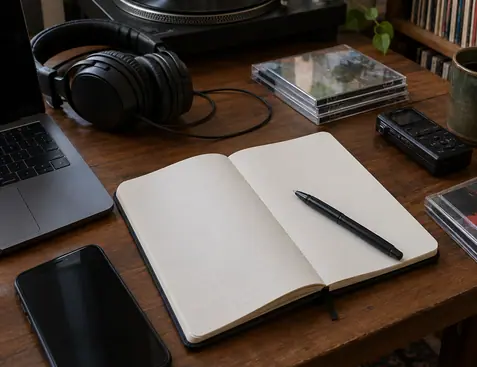
- Create one notes file per mix. Put the DJ, mix title and date saved in its name. Keep that wording aligned with the downloaded file so similarly titled editions stay separate.
- Log while the transition plays. Record the position in mm:ss before the blend finishes. An entry such as “female vocal, log drum, Yoruba hook” preserves a searchable listening memory even when the identity remains unknown.
- Identify from the cleanest passage. Replay a little before the overlap and run a music-recognition app where one record is clearest. Edits, pitched vocals, sped-up versions and unreleased tracks can defeat recognition, so keep unresolved entries visible.
A compact line can read: “23:40 | Artist feat. Artist | Title | amapiano refix | likely”. These are placeholder names, not credits. The final field matters: “likely” records a working identification without presenting it as settled.
Keep the Version Open
A recognition match can identify the underlying song while missing the DJ's edit. Confirm the title and version separately before replacing an uncertain entry.
Use an artist's release listing to check spelling and featured performers when available. If a producer credit remains unavailable, leave it unresolved rather than filling the gap from memory. Later music news and release-day uploads may supply the missing connection.
That distinction keeps a personal log useful when it becomes a shared tracklist. Another listener should be able to see which entries are confirmed, which remain likely and which still read “ID.” Preserve the timestamp through every revision.
Before You Save Your Next Mix, Open the Log First
The keep-worthy standard is straightforward: a timestamp, artist, title and version for every released record, with featured artists included. Producer credits deepen the route into the scene. When the upload supplies less, your listening log can recover some of that missing access.
Credits Keep Discovery Moving
A credited mix gives listeners a discovery tool and gives its artists an exposure channel that continues after playback ends. Across mixtapes & playlists, those small entries let a memorable voice lead somewhere.
Before pressing play on your next downloaded Naija mix, create its notes file with the DJ, mix title and date saved; then write your first timestamp and track ID, or an “ID” placeholder, before the first transition passes.