What This Guide Covers
Artist research in Afrobeats works best when the path stays modular. A discography question may not need the social timeline. A disputed chart claim may send you straight to chart bodies and certification language.
This guide uses seven research steps, each tied to a source class: DSP catalogues, credit registries, official charts, interviews, social posts, live-history records, and myth-check logs. For a mid-catalogue artist profile, the reading-to-application span usually runs about 3 to 6 working days when the source log starts from zero.
In this Article
- Why Rigorous Artist Research Matters in Afrobeats
- Criteria for a Reliable Source: How Journalists Rank Evidence
- 1. Map the Full Discography from Official Releases
- 2. Verify Songwriting and Production Credits
- 3. Trace Chart History Through Official Bodies
- 4. Collect and Contextualise Interviews
- 5. Build a Social Media Timeline for Chronology
- 6. Document Live History and Performance Reach
- 7. Run the Myth Check Before Publication
- Turn the Source Log into a Publishable Profile
Main Point: Use the linked navigation as a working desk, not a classroom path. If you are updating an existing feature, skip directly to chart history and the social-timeline audit.
Why Rigorous Artist Research Matters in Afrobeats
Afrobeats has moved from scene knowledge to chart infrastructure. Across roughly 2019 to 2023, Nigerian pop and its adjacent West African movements gained firmer visibility on Billboard, the Official UK Charts, and dedicated Nigerian chart systems.
That shift changed the stakes of a profile. A fan thread can travel faster than a correction. A Wikipedia edit can freeze a rumour into search results. A viral tweet can turn a genre-chart peak into a supposed all-genre No. 1 before anyone checks the chart name.
The discipline is simple and unforgiving: no career claim goes to publication on one source. I use triangulation as the floor, not the finish line. A release date needs catalogue support. A chart peak needs the recognised chart body, the chart name, and the relevant week. A sales claim from an interview remains a claim until a primary record can carry it.
That may sound severe for music news, but Afrobeats history deserves the same evidentiary pressure as political reporting or business coverage. The culture is too inventive to be documented lazily.
Criteria for a Reliable Source: How Journalists Rank Evidence
Rank the evidence before you chase the story. Otherwise, the loudest item in the search results will start making editorial decisions for you.
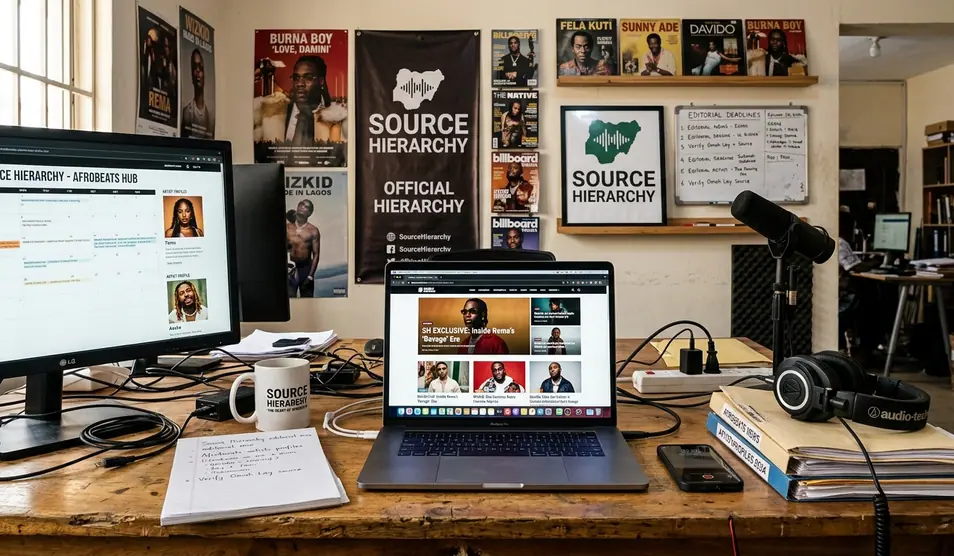
At the top sit primary records: label credits, official releases, PRO registrations, chart bodies, ticketing archives, venue listings, and documents with traceable provenance. Under those come secondary reporting from established outlets. Social chatter sits last, useful for signal and chronology but weak as proof.
Three buckets keep the research clean
- Verified fact: the claim has primary support or at least two independent sources that do not appear to copy one another.
- Artist self-narrative: the claim establishes what the artist said, not whether the statement is true.
- Fan myth: the claim circulates widely but lacks a traceable record or relies on screenshots with no source path.
Every data point needs a capture date. Streaming totals change. Chart positions live inside weekly cycles. The difference between a verified milestone and a flattering myth can be a seven-day frame.
Caution: The two-source rule bends only for one-of-a-kind records, such as an original label contract or a PRO registration, and only when provenance is documented. For pre-streaming Nigerian catalogues, the archive can thin out fast.
1. Map the Full Discography from Official Releases
Start with the release timeline because every later question hangs from it. If the chronology bends, the profile bends with it.
Pull the artist page from Apple Music, Spotify, and Boomplay, then compare those records with distributor data where available. MusicBrainz can help surface alternate versions, spelling variants, and early uploads, while official label pages often preserve campaign sequencing better than DSP front ends.
The practical rule: cross-check at least three catalogues. Use one DSP, one distributor or label record, and one open database. This matters most for Nigerian mixtapes & playlists from the 2010 to 2015 period, where dates often conflict or disappear across platforms.
One small example carries the whole problem. An artist's 2013 mixtape may show a 2019 release date on a DSP because a distributor switch forced a re-upload. If you treat that DSP date as original, you place the tape after songs it actually preceded, and the whole arc of influence collapses.
Discography fields to log
- Title as displayed on the official release.
- Release type: single, album, EP, mixtape, deluxe, compilation, or reissue.
- Earliest catalogue date found.
- Label or distributor name attached to the release.
- Tracklist order and featured-artist billing.
- Notes on deletion, re-upload, alternate cover art, or retitling.
Expert Tip: Flag any release whose earliest catalogue date comes after a documented interview, live performance, or chart mention of the same song.
2. Verify Songwriting and Production Credits
Credits reveal the engine room. They show who shaped the bounce, who tightened the hook, who carried the melodic grammar from one era into another.
Do not rely on DSP metadata for older Nigerian works. Those fields often arrive thin, absent, or flattened into generic contributor lines, especially before streaming adoption widened around 2015. Lead instead with liner notes, publisher databases, and PRO registrations.
For international works, check ASCAP and BMI. For Nigerian-registered compositions, check COSON where records can be matched. Build a dedicated column for featured-artist billing and another for uncredited or alleged ghost contributions, because those are not the same category.
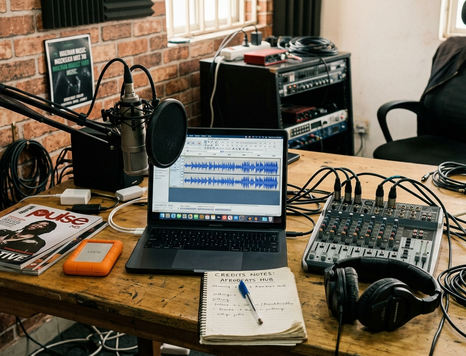
A recurring producer can define an artist's sound more clearly than a press quote. Listen for producer tags, but verify them. If the same producer appears across breakout singles, album cuts, and remixes, the profile can speak about continuity with evidence instead of mood.
Credit questions that sharpen a profile
- Which producers appear at career turning points?
- Which co-writers cluster around the artist's strongest albums & eps?
- Did a collaborator move from featured billing into writing or production roles?
- Does the public narrative overstate independence or understate a creative partnership?
This section often changes the language of a feature. Instead of saying an artist reinvented themselves alone, the sourcing may show a tighter claim: the reinvention came through a new writing room, a new producer pair, or a label-era change in personnel.
3. Trace Chart History Through Official Bodies
Chart inflation is the most common error in Afrobeats profiles. It usually starts with one missing noun.
A song did not merely chart. It charted on a specific chart, during a specific week, at a specific peak. Billboard, TurnTable Charts, and the Official UK Charts archive each measure different markets and frames. Treat them as separate instruments, not interchangeable proof.
Record the peak position, chart name, and chart week for every entry. Keep genre charts separate from all-genre charts. A No. 1 on an Afrobeats or genre-specific listing can be meaningful, but it does not equal a No. 1 on an all-genre national chart.
Caution: A viral streaming screenshot is not a chart placement. Treat it as social chatter unless a recognised chart body publishes the entry.
The cleanest chart note reads plainly: song title, chart body, chart name, peak position, chart week, capture date. Anything less invites myth-making.
4. Collect and Contextualise Interviews
Interviews carry motive, memory, posture, and contradiction. They rarely carry hard fact by themselves.
Prioritise on-record interviews from established outlets over paraphrased quotes. Log the publication date, outlet, interviewer when available, and the exact claim being made. A statement from 2016 may reflect ambition; a statement from 2023 may reflect reputation management. Both can belong in the same profile, but not with equal evidentiary weight.
Artist self-reporting often drifts between tellings. A first studio session becomes a first professional recording. A local hit becomes a national breakout. A self-funded video becomes an origin myth for total independence.
How to treat interview material
- Quote the artist accurately and preserve the publication date.
- Separate emotional truth from factual claim.
- Cross-check milestones against releases, charts, contracts, credits, or live records.
- Tag unverified sales claims until a chart body or certification supports them.
An interview quote proves what an artist said. It does not prove that the milestone happened exactly as remembered.
5. Build a Social Media Timeline for Chronology
The social timeline fixes sequence. It does not settle truth.
Use timestamped posts to anchor announcements, collaborations, video shoots, label disputes, apology notes, tour reveals, and release delays. Confirm that the account is verified or officially linked from the artist's website, label page, or another primary channel before logging it.
Deleted posts need extra care. Archived captures can help when the snapshot falls close to the original posting, ideally within days. Screenshots without archive paths should sit in the notes column, not the factual timeline.
Social-timeline fields
- Platform and account handle.
- Verification or official-link status.
- Post timestamp and capture date.
- Claim or event announced.
- Archive link or screenshot source path where relevant.
- Status after release, chart, interview, or label confirmation.
A collaboration teaser is sequence evidence until the song appears. A dispute post confirms public escalation, not the private facts behind the dispute.
6. Document Live History and Performance Reach
Live history shows a different kind of power. Streams can travel without bodies in a room; touring asks whether the artist can convert attention into presence.
Build this section from verified ticketing archives, festival line-up records, venue listings, and day-of reviews. Record headline versus support billing for each date. A support slot at a major arena and a headline date at a smaller hall tell different stories, even if the poster places both names in bright type.
Commercial reach has to obey physical limits. If a promoter announces sold-out attendance exceeding the venue's licensed capacity, use the capacity figure as the defensible ceiling. The higher number may reveal hype; it cannot become fact.
Main Point: A festival poster confirms booking. To record the debut as completed, look for day-of footage, reviews, setlist traces, or official festival recap material.
One milestone deserves special attention: the first international festival appearance. It often marks the point where an artist's local momentum enters a wider booking economy.
7. Run the Myth Check Before Publication
The final audit is not a tidy-up. It is where the profile decides what it can responsibly say.
Common myth patterns repeat across Afrobeats features: inflated sales figures, exaggerated first-ever claims, misattributed production credits, and genre-chart peaks presented as mainstream domination. Put every disputed item into a myth-check table with a source count and a status flag: verified, unconfirmed, or disputed.
Some early-career firsts will stay unconfirmed forever because no chart, registry, or newspaper archive covered that period in usable form. Do not solve that absence with confidence. Name the gap, then move to what the record can support.
Myth-check questions
- Who first made the claim?
- Did later sources copy that claim or independently verify it?
- Does the claim rely on a fan account, a press release, or a primary body?
- Would the wording change if the chart type or release date were stated precisely?
The best myth-checks do not flatten an artist's legend. They protect it from lazy exaggeration.
Turn the Source Log into a Publishable Profile
Once the seven steps are complete, write from the log outward. Keep the source log as a separate running document, keyed to each claim in the narrative. That structure lets an editor audit the profile later without reconstructing the whole search.
A strong artist profile should move between charisma, craft, and power. The discography gives sequence. Credits expose creative labour. Charts mark market recognition. Interviews reveal self-fashioning. Social posts fix public chronology. Live records show reach. The myth-check protects the reader from inherited noise.
The result is not a sterile file. It is a better feature: sharper on influence, fairer to collaborators, less vulnerable to fan war, and more useful to the archive that future music news will inherit.