Afrobeats playlists work best when they answer a practical question: what does this room, journey, or hour need from the music? A strict genre label can identify a sonic family. It rarely explains whether a track belongs in the first ten minutes of a wedding, the hardest stretch of a gym session, or the quiet ride home.
That distinction matters because Afrobeats moves easily across production registers. The strongest mixtapes & playlists organize that movement around mood, location, and social moment, using genre metadata as supporting information rather than the final sequencing rule.
How Afrobeats Playlists Grew Out of Rigid Genre Tags
Early streaming catalogs inherited genre trees shaped largely around Western market categories. Between roughly 2015 and 2019, major taxonomies often collapsed Afrobeats, alté, Afro-fusion, and amapiano-leaning tracks into a flat “Afrobeats” or “African” label. A curator building a Naija set could therefore encounter radically different grooves inside the same folder, with little metadata to explain how those tracks might function together.
Amapiano’s accelerating crossover into Nigerian releases across 2020 to 2022 put that system under greater strain. Log drums, Afro-pop hooks, R&B vocal phrasing, highlife guitar, and street-pop cadences could share one release cycle, sometimes one album. The label remained useful for broad discovery, yet it offered weak guidance for sequencing.
The Room Became the Index
DJs and fans already had a more flexible method. Nigerian party and street-DJ traditions place close attention on the room: who has arrived, who is singing, when dancers need a lift, and when familiarity matters more than novelty. As streaming playlists became everyday social tools, that reading of the room migrated into personal libraries.
Occasion began to outrank subgenre. A track entered the wedding folder because its chorus united generations. Another entered the commute rotation because its melody held attention without demanding dance-floor intensity. The practical thesis follows: strong Afrobeats playlists are curated first by mood, location, and social moment.
A Curator’s Boundary
This shift reflects sustained listening across releases rather than audience survey data. It should be read as a curator’s interpretation of playlist practice, not a measured trend line.
Why Mood Curation Connects Deeper Than Genre Labels
Genre tags document production choices. They can point toward drum patterns, instrumentation, tempo traditions, or a track’s relationship to an established scene. Mood tags capture the listener’s setting and emotional demand: momentum for training, warmth for arrivals, release for a celebration, or intimacy after midnight.
Afrobeats makes that separation especially useful. A full-length album from a headline artist commonly moves through three or more production registers across a dozen or so tracks, from amapiano-inflected dance cuts to stripped Afro-R&B. Filing the whole album under one narrow genre hides those internal shifts. Splitting every track into increasingly precise subgenres creates a different problem: the categories become too brittle for ordinary listening.
Context Sets the Test
Listeners often reach for music through an activity window. A commute may last 25 to 45 minutes. A gym block may run an hour to an hour and a half. In each case, the playlist must sustain a specific kind of attention across time. BPM sorting alone cannot identify a motivational vocal cadence, a chorus suited to group singing, or a sparse arrangement that leaves room for late-night conversation.
Mood curation starts with function, then uses sonic details as evidence. The question changes from “Which genre folder holds this track?” to “What will this track do at minute 30?” That shift gives sequencing a purpose beyond similarity.
The Five Mood Archetypes That Define Modern Naija Playlists
Five recurring archetypes cover much of modern Naija playlist practice. Curators can define each one by identifying the emotional cue that triggers the selection, then working backward to the sonic traits that support it.
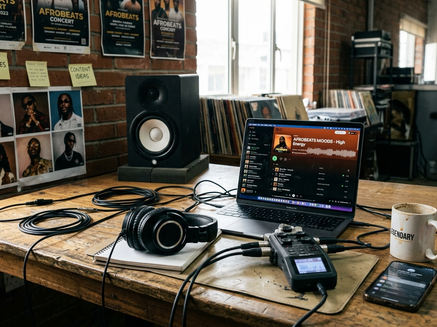
Gym: Drive Without Drift
Gym selections sit at the high-energy end. Driving percussion, forceful low-end movement, and motivational vocal cadence matter more than a narrow subgenre match. A melodic mid-tempo track may sound lively through laptop speakers yet lose force during high-exertion training. The body supplies the decisive test.
Commute: Melodic Continuity
A commute playlist favors mid-tempo movement, clear melodies, and hooks that remain inviting through headphones. Singalong value helps, but the sequence should avoid repeated peaks. The goal is sustained motion across a defined journey rather than the dramatic rises expected on a dance floor.
Weddings and Celebrations: Shared Recognition
Celebration sets need crowd-uniting records. Highlife and Afro-pop crossovers often earn central positions because they can connect teenagers, parents, and elders in one room. Familiar refrains, chant-friendly passages, and clean transitions create collective participation. Here, cultural recognition can outweigh novelty.
Diaspora: Memory With Movement
Diaspora playlists operate through place and memory. Mid-tempo favorites can reconnect a room to earlier parties, family journeys, or a particular city’s Naija scene. Those reference points remain local. A nostalgia anchor that lands with a London-based crowd may miss with Lagos residents whose idea of a classic comes from a different period or setting.
Late Night: Space and Texture
Late-night programming occupies the slowest energy band. Sparse arrangements, softer percussion, and intimate Afro-R&B vocals allow the room to settle without cutting the social thread. These tracks work as a landing phase after dancing or as a self-contained playlist for low-light listening.
The five archetypes form a working map rather than an exhaustive catalog. A study-focus block or house-party warmup may require a sixth mood built around its own setting and emotional task.
Addressing the Case for Keeping Genre Structure
The argument for genre structure deserves its strongest form. Genre tags help listeners discover scenes, give emerging artists a recognizable category, and provide recommendation systems with consistent inputs. Genre metadata also remains load-bearing for rights administration, royalty splits, archival cataloging, and licensing databases.
Mood curation addresses a narrower layer: listener-facing playlists. It leaves catalog infrastructure intact.
Two Layers, Different Jobs
A useful system keeps the genre field and adds mood tags above it. An amapiano-inflected Afro-pop track might retain those production descriptors while receiving separate tags for “celebration,” “peak dance floor,” and “high drive.” The genre explains where the sound sits culturally and technically. The mood tags explain when to play it.
Subjectivity remains the central constraint. Mood labels are difficult to standardize across a large catalog, especially when the same track changes function across cities or age groups. Automated back-end sorting therefore still benefits from stable genre metadata. Human-facing playlists gain precision from the second, contextual layer.
A Practical Method for Tagging Tracks by Mood
The most reliable workflow begins before track selection. Define the event or activity, establish the required energy, and write down the emotional intent. Only then should the curator search the library.
1. Describe the Moment
Use a compact brief: “weekday evening commute, headphones, steady movement, familiar hooks.” A gym version might read: “high-exertion training, forceful percussion, minimal energy dips.” Specific language prevents attractive but unsuitable tracks from entering the queue.
2. Apply Functional Tags
- Setting: gym, commute, wedding, house party, or late night.
- Energy: warm, rising, high drive, sustained peak, or cooling.
- Emotional intent: nostalgia, confidence, celebration, intimacy, or release.
- Vocal texture: chant-led, melodic, conversational, sparse, or crowd-facing.
Tempo and vocal texture should operate as diagnostic tools. A fast track with a restrained vocal may fit a commute better than a celebration. A slightly slower record with a commanding chorus may lift a room more effectively.
3. Build the Arc
A workable session uses four phases: an opening tenth or so that establishes tone, a build, a sustained peak, and a wind-down covering the final fifth. Sequence by changing crowd state instead of rotating artists evenly. Each transition should either raise energy, preserve it, or release it deliberately.
4. Test in Context
Play the complete sequence in its intended environment and prune any track that breaks the mood. A gym set auditioned at a desk will allow mid-tempo selections that collapse under exertion. One real training session exposes them quickly. The same rule applies to commutes, parties, and late-night listening.
Case Study: Building a Diaspora House-Party Set Step by Step
Consider a two-hour diaspora gathering. Guests arrive in small groups, conversation dominates the opening, the room later turns toward collective dancing, and the final stretch needs a controlled descent. The playlist should follow those changing states across roughly two hours.
Step 1: Open With Nostalgia
Allocate about half an hour to warm, mid-tempo tracks associated with shared memory. Choose melodic records with recognizable hooks and enough rhythmic movement to signal a party without overrunning conversation. Order them from relaxed to gently assertive.
Localize this block carefully. For a London-based Naija crowd, select favorites tied to that community’s parties and listening history. For guests whose reference point is Lagos, replace those songs with the classics they claim as their own. The slot remains “warm nostalgia”; its contents change with the room.
Step 2: Create the Celebratory Lift
Use the next half hour or so for Afro-pop anthems, highlife crossovers, and chant-friendly choruses. Begin with a record that feels related to the nostalgic opener through melody or vocal familiarity. Follow it with increasingly percussive selections. By the end of this phase, guests should have moved from recognition to participation.
Step 3: Hold the Dance-Floor Peak
Reserve roughly 35 to 40 minutes for the highest-drive material. Pull in dance-floor crossovers, amapiano-leaning Nigerian cuts, and tracks with forceful rhythmic signatures. Avoid spending the strongest records in the first few minutes. Start the block with an obvious invitation, place the hardest run in the middle, then use the final selection to signal that the peak is ending.
Step 4: Land in Afro-R&B
Give the last 20 to 25 minutes to late-night Afro-R&B, softer percussion, and spacious vocals. The first cooldown track should preserve a rhythmic connection to the peak while reducing density. Each following selection can open more space until conversation returns to the foreground.
To copy the method, create four empty folders labeled “Arrival 30,” “Lift 35,” “Peak 35,” and “Cooldown 20.” Fill each folder according to its mood, replace nostalgia picks with favorites specific to the guests’ city, then play the folders in that order without shuffle. If the same library must serve tomorrow’s solo commute, keep 25 to 45 minutes of the mid-tempo singalong core and remove the dance-floor peak entirely.