Who Answers for the Night When the Lights Go Up?
Afrobeats commands global charts, yet its homecoming season remains a logistical frontier. When a Lagos festival gate jams, a set starts ninety minutes late, or a fan cannot find water at 1 a.m., someone holds the responsibility. Accountability splits across four distinct parties in a typical Lagos festival: the promoter, the venue, the headliner, and the ticketing platform — fans usually only hold a receipt from the fourth.
The December circuit has scaled its stages and lineups faster than it has scaled crowd management, crew depth, ticket disclosure, and basic fan services. Peak congestion hits hard between 18 December and 2 January. A single weekend carries three to five multi-thousand-capacity outdoor events in Lagos alone.
Readers need concrete, checkable benchmarks to navigate this density. A chronology of lineups answers nothing about accountability. Tracking the operational mechanics shows who answers for the night.
How the Circuit Outgrew the Infrastructure Holding It Up
The ecosystem shifted rapidly from a handful of anchor events and club-scale shows to a dense December calendar. Festivals, beach concerts, brand activations, and diaspora-facing weekenders now dominate Lagos, while increasingly expanding into Abuja, Port Harcourt, and Accra.
The demand is clear.
Returning diaspora audiences flood the city, expecting production values matching the ticket prices. Artists bring years of global touring experience back home. Headline sets that once only existed on foreign festival stages now anchor local bills. On the supply side, the same limited pool of production companies, LED suppliers, generator vendors, security firms, and stage crews serve overlapping dates in a tight two-week window.
Tracking vendor movements across two December runs highlights the operational strain. A load-in scheduled for three days routinely compresses to 18 to 30 hours when a site is shared with another event or released late by the landholder. Soundcheck windows disappear first under this compression.
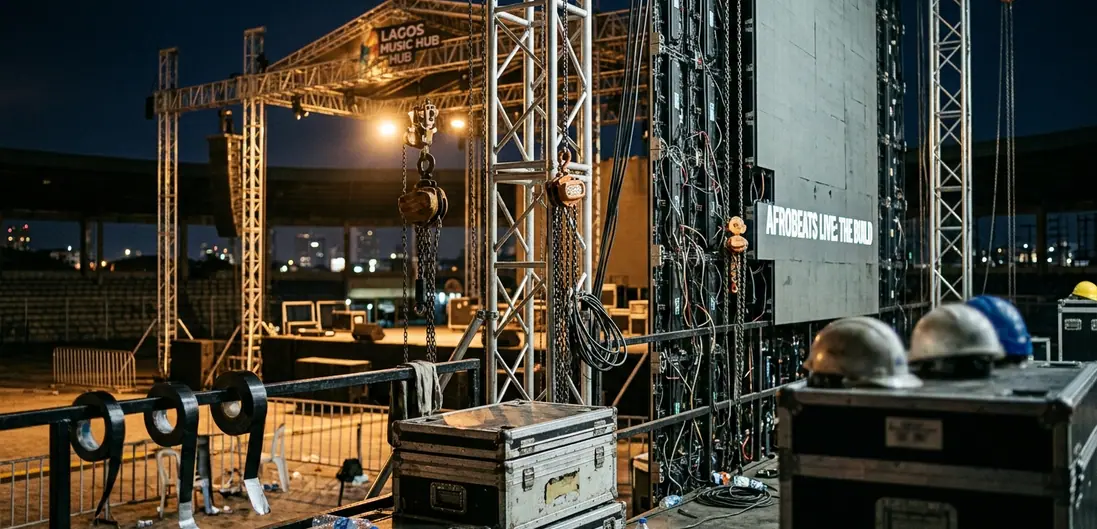
Rental stock dictates the visual scale of the season. LED walls arrive as 500 by 500 mm modules pulled directly from a job that struck the previous night. Generator provision usually quotes a 500 kVA primary with a smaller house set, skipping a tested primary-plus-standby pair with seamless changeover.
Crowd Safety Belongs on the Budget Sheet
Fans recognize the recurring failure points across the circuit. Single-entry bottlenecks, gates opening hours late, crush pressure at barrier fronts during headline sets, unlit exit routes, and missing medical posts dominate post-show discussions.
A beachfront show recently demonstrated the severe risk of a combined entry and exit lane. The gate opened roughly two hours late. Arrivals pushed in while early leavers tried to exit, forming dangerous crush pressure at the funnel rather than the barrier. The pit crew never saw the surge, rendering safety hand signals completely irrelevant.
Fixable mechanics carry a specific cost line on the budget sheet. Promoters must publish capacity figures and stagger gate times by tier in 30 to 45 minute bands. Entry and exit lanes require physical separation so egress never runs against arrivals. Barrier design needs a front-of-stage pit behind a 1.1 to 1.2 metre barrier, with spotters posted every 8 to 10 metres of barrier face. Marked egress paths must stay lit and staffed until the site clears.
Medical provision requires a stated commitment on the on-sale page. This includes the ambulance count on site, a lit and signposted first-aid point mapped on the site plan, and a named safety officer with written authority to halt a set. The pit crew needs briefing 60 to 90 minutes before doors on the exact hand signal that stops the show.
These figures are calibrated for outdoor, multi-thousand-capacity sites with more than one entry point. A rooftop or warehouse show of something like 600 capacity cannot stagger four gate bands and will not carry two ambulances; its obligations shift to occupancy counting at a single door, a clear second exit that is unlocked and unblocked all night, and one trained first-aider whose name the door staff actually know.
Promoters aligning with public guidance on event safety and crowd management build trust before the first ticket sells.
The Crews Behind the Sound: Rehearsal, Redundancy and Getting Paid
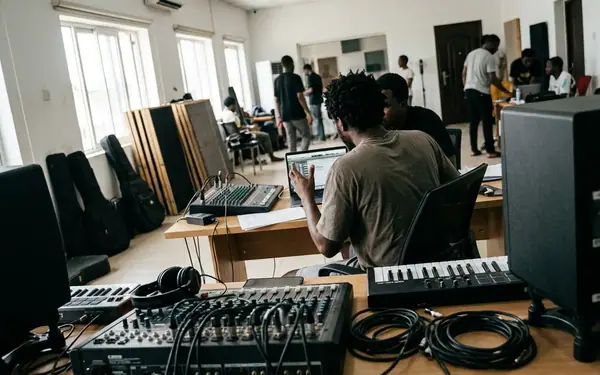
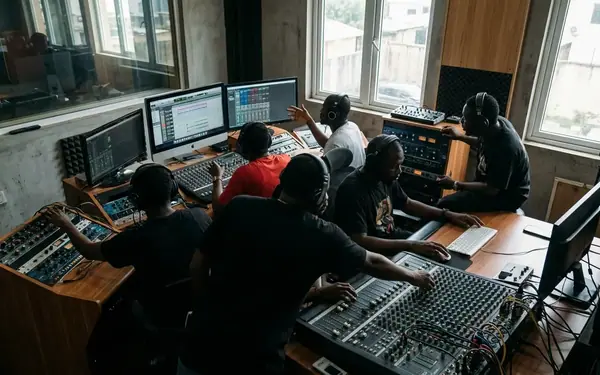
Production quality remains a labour question first. Monitor engineers, backline techs, riggers, stage managers, and generator operators decide whether a headline set lands or collapses. The crews working 18-hour shifts across multiple sites carry the actual weight of the season.
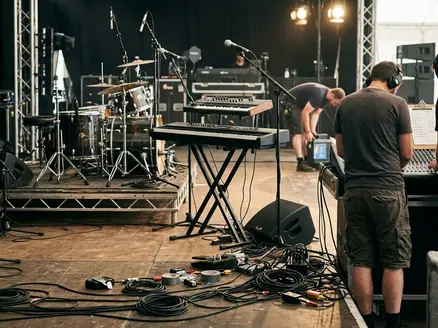
Advance work draws the dividing line between success and failure. A technical rider received and answered in writing 14 to 21 days before doors sets the foundation. The input list and stage plot need reconciliation 7 to 10 days out. A run-of-show with named department heads for audio, lighting, video, stage, power, and security must circulate at least 7 days before doors. Artists require a genuine 45 to 60 minute soundcheck per headline act instead of a line-check in the dark.
Advance Planning Takeaway Conversations in car parks with monitor engineers detail the same sequence in the same order: late riders and unreconciled input lists directly cause mid-set audio failures.
A recent failure case illustrates the alternative. A headline rider arrived three days before doors on a shared-vendor weekend. The input list went unreconciled. The set ran on a 10-minute line check after dark, the monitor mix collapsed in the first two songs, and the public verdict landed unfairly on the artist rather than the advance timeline.
Redundancy costs very little compared to failure. Productions need a spare console or at least a spare channel path. Standby generators require a changeover physically tested during load-in rather than assumed. Duplicate playback rigs must have the backup deck armed. Wireless frequencies need coordination across all stages before the first act to prevent mid-set collisions.
Payment terms belong in the crew contract. A deposit secures confirmation, and the balance requires settlement within 7 to 14 days of load-out. Crews settled 60 days late, more or less, simply find other gigs the following December.
What a Ticket Tier Should Actually Promise Before You Pay
The disclosure gap in ticketing creates immediate friction. Fans buy 'VIP', 'Table', and 'Backstage' tiers blindly. Promoters frequently omit definitions of sightline, seating, entry lane, drink inclusion, or restroom access.
A defensible on-sale page carries five specific items. It states total capacity per tier. Every tier spells out exactly what it physically grants. Service and platform fees appear before checkout rather than at the final screen. A lineup change and refund policy sits clearly at the point of sale, avoiding social media negotiations after a headliner cancels. Set times go public no later than 24 to 48 hours before doors.
Show-day gate discounts inside the final 6 to 8 hours before doors punish the buyers who funded the site build. These late discounts train audiences to wait. That hesitation wrecks cashflow planning for the following year.
Water, Wayfinding and Waiting: The Services Nobody Puts on a Flyer
Walking sites after doors reveals the true state of fan services. The climate reality of Lagos in December mixes Harmattan dust with intense humidity.
Free potable water functions as a baseline safety provision. Heat, dense crowds, and long queues create a dangerous medical combination. Sites need at least one free station per 1,000 attendees, located within 50 to 60 metres of the densest standing areas. These stations require staffing and re-supply on a written schedule rather than refilling only when someone complains.
Servicing and legibility dictate the fan experience. Portable restrooms should sit at roughly one unit per 85 to 100 attendees for a show running longer than six hours, serviced every 3 to 4 hours. Walkways need end-to-end lighting. Directional signage must remain legible at 15 to 20 metres at night.
Queue design for bars and food requires offline fallbacks. Cashless wallets fail when network coverage degrades under crowd density before the headline set. Unspent wallet credit needs a stated refund window of 5 to 7 business days. A lost-and-found point must remain staffed at 10 a.m. the following morning. Ride-hail pickup zones require marshalling as part of the show operations.
A Scorecard for the Next December Run
Accountability requires measurement. Readers can carry a consolidated checklist into the next on-sale announcement.
Promoter checks operate on a pass/fail basis using published evidence. The capacity figure, named safety officer, ambulance provision, and first-aid details must appear publicly. Gate times need listing by tier. Refund policy stays visible at the point of sale. Anything requiring a direct message to confirm scores as a fail.
Artist and fan checks attach specific times to deliverables. Riders must arrive 14 to 21 days ahead. Artists must arrive inside the allotted soundcheck window. Set lengths agreed in the run-of-show require strict adherence to the minute. Fans should screenshot set times when published and locate water points and the nearest two exits within the first 15 minutes on site.
Four in the Morning, Somewhere Off the Lekki–Epe Expressway
The crowd clears out. LED panels come down in banked sections. A monitor engineer coils XLR cable by phone torchlight because the site lighting was struck before the stage was clear. One generator still hums for the last truck.
A steward walks the barrier line, filling a crate with lost slippers, phones, and single earrings. The promoter stands by the gate, counting wristbands against the final report. The medical log and incident notes change hands. A lost-property list goes live, ensuring the plastic crate has an owner by mid-morning.