Put on a chart-topping street-pop record at a Saturday wedding reception in Ikeja, and you will find out within thirty seconds whether the label cared about the clean version. When a chorus drops completely silent right on the downbeat, the energy in the hall stutters. Guests mid-step look toward the DJ booth, wondering if the mixer cable just came loose.
As Afrobeats expanded into a global powerhouse, the settings where the music lives multiplied. The engineering workflow behind the scenes, however, largely stayed stuck in the club era. For artists, DJs, and curators putting together mixtapes & playlists, a poorly executed radio edit now costs real momentum where it matters most.
How the Radio Edit Became Afrobeats' Afterthought
For decades, the broadcast edit started as a regulatory gate to get through. A label's release workflow revolved around the club or album master. That primary file got the session engineer's full attention across days or weeks of careful mixing. Once the main mix was signed off, broadcast requirements were checked against that finished master to clear airplay standards in Nigeria, where the broadcast regulator has periodically restricted songs over explicit content.
Because the clean version was treated as a compliance file, labels commonly turned it around in the last 24 to 72 hours before a release or radio-servicing deadline. Often, an assistant or a junior editor prepared it quickly from a two-track bounce without the original mix engineer in the room.
That habit collided with a massive cultural shift between 2019 and 2023. During those years, Afrobeats singles moved aggressively from late-night club rotation into mainstream daytime radio, global editorial features, and multigenerational family celebrations. The music now anchors owambe parties, weddings, naming ceremonies, and church-adjacent events. On streaming platforms, an explicit tag automatically routes listeners with content filters enabled—including family plans and workplace accounts—toward the clean entry. For millions of listeners, the clean master is the default version they hear.
The result is an awkward gap in quality control. The club version gets the sonic polish, while the rushed clean version is the one actually playing for some of the widest, most diverse audiences the genre reaches.
Dead Air, Reversed Vocals and Broken Hooks: Where Rushed Edits Fail
When an editor has to clean a track from a finished stereo file with no session stems, their toolkit shrinks to blunt instruments. Every audible failure on a bad radio edit traces directly back to the shortcut used to make it.
The clean-edit failure breakdown splits into four distinct layers, ranked by how much damage they do to a record's momentum:
- Hollowed-out chorus hooks: A silenced or reversed word on the second line of a repeating Afrobeats chorus is the worst offender. Hooks in this genre usually recur on the order of three to four times per track, so a single crude cut inside the chorus hits the listener again on every repeat. Hard muting creates sudden dead air that breaks dancefloor momentum and draws immediate attention to the missing word. Reversed-vocal patches sound jarring and dated, especially when they land on the downbeat of a hook and flip the percussive attack backward.
- Multilingual blind spots: Pidgin, Yoruba, or Igbo slang missed by an English-only word list comes next. Many Afrobeats and street-pop hooks code-switch across three or four languages inside a single eight-bar phrase. Editors screening lyrics solely against standard English broadcast lists leave in local street slang that any Naija parent or broadcaster will immediately flag, while sometimes cutting harmless indigenous words that merely sound suspicious to an unfamiliar ear.
- Broken rhythmic pockets: A patch that drifts off the rhythmic grid follows close behind. At 108 BPM, a common mid-tempo Afrobeats and street-pop pace, one beat lasts about 555 milliseconds and a sixteenth note lasts about 139 milliseconds. A vocal patch or instrumental paste that slips even a fraction of a sixteenth off the grid smears the log-drum and shaker pocket. Dancers feel that timing hiccup in their feet before they can name what went wrong.
- Sudden volume drops: A 1 to 3 dB level dip around the muted bar is the least costly fault, though still distracting. When an editor ducks a full stereo file or splices in an unmastered instrumental bar, that 1 to 3 dB drop registers as a noticeable sag on a loud PA system or in a quiet car, especially when the surrounding chorus is heavily compressed.
What Owambe and Daytime Listening Tests Reveal About Clean Versions
Studio monitors hide how awkward a bad edit feels in a crowded hall. To see how these versions perform in the wild, a Codnima contributor documented listening tests of clean Afrobeats edits across multi-hour family gatherings and daytime events—settings where the clean version is the mandatory default across a full afternoon and evening, with grandparents and children sitting right alongside the core dancers.
Playing clean edits in the natural flow of a daytime set reveals immediate physical cues in the crowd. When a hard mute or a reversed vocal lands inside the groove, dancers hesitate or stop mid-step as the rhythm drops out from under them. Older guests sitting near the perimeter frequently turn their heads toward the speaker stacks at a jarring patch, reading the sudden silence or backward slur as a technical glitch. Worst of all for a hit single, group singing falls apart the moment a chorus hits a hollowed-out hook line.
Tracks cleaned with re-sung lines or seamless instrumental fills tell a completely different story. When the rhythm stays intact and the melody carries a replacement lyric, the floor keeps moving without a ripple. The singalong carries straight through the chorus, and the edit draws no visible reaction from the room.
Silence, Re-Sings and Instrumental Fills: Comparing Clean-Edit Techniques
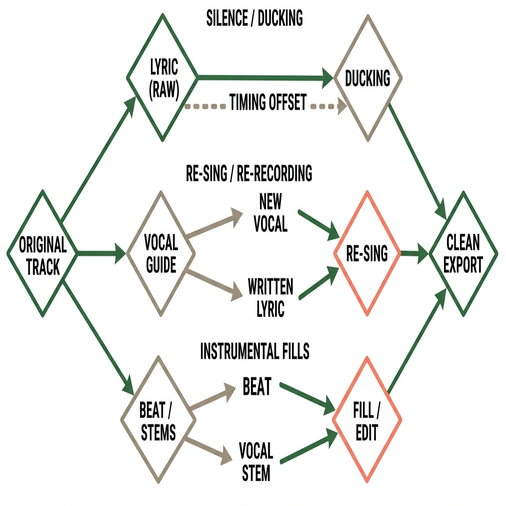
What separates an invisible edit from a trainwreck comes down to what assets the editor holds when the work begins. With only a stereo master, an editor is trapped between muting, reversing, dropping a sound effect, or pasting an ad-lib from elsewhere in the track. With multitrack stems, vocal chops and instrumental bridges open up. With the artist still at the microphone, a true re-sung line becomes possible.
| Edit Technique | Noticeability | Does the Hook Survive? | Required Assets | Best Use Case (Club / Radio / Playlist) |
|---|---|---|---|---|
| Hard Mute | Extremely High (creates dead air) | No; collapses singalongs | Stereo file only | Emergency compliance only; fails in clubs and playlists |
| Reverse Vocal | High (jars the rhythmic pocket) | Rarely; breaks downbeat flow | Stereo file or vocal stem | Passable in verses on radio; disruptive in hooks |
| Sound-Effect Drop | High (draws attention to the cut) | No; masks melody with noise | Stereo file + SFX library | Mixtape hosting or street-radio tags; poor on streaming |
| Ad-Lib Swap | Moderate (depends on phrasing) | Partial; keeps vocal texture | Stereo file or stems | Short single-word verse edits on radio and playlists |
| Vocal Chop / Melodic Fill | Low (if under half a bar) | Yes, for 1–2 off-beat syllables | Full session stems | Club sets and daytime radio when stems are available |
| Full Instrumental Bridge | Low to Moderate (leaves a vocal gap) | Rhythm survives; lyric drops out | Instrumental master + stems | DJ blends and background playlists; weak on vocal hooks |
| Re-Sung Alternate Lyric | Invisible (sounds like original master) | Yes; preserves melody and bounce | Artist in booth + session stems | Universal: daytime radio, owambe sets, streaming albums and EPs |
A vocal chop or melodic fill holds up well when replacing a single word of one or two syllables placed off the beat, but it tends to fall apart once the replaced phrase runs past roughly half a bar inside the hook. Re-sung alternate lyrics recorded at the original session deliver the most seamless results across every environment, though a DJ working only from a finished stereo bounce cannot take this route; it requires artists and engineers to plan ahead during the vocal session itself.
Capturing those clean alts while the artist is still in the booth adds about 15 to 30 minutes at the end of a recording session. That half-hour investment saves days of scrambling later, when the vocal chain, microphone position, and the singer's voice have all shifted.
Five Checks Before a Clean Edit Joins Your Crate or Playlist
When I sit down to vet new singles for a daytime set or a curated playlist, I run every clean file through a five-step sequence ordered so the fastest, cheapest test to fail comes first. Why spend in the neighborhood of twenty minutes checking phase alignment in software if the chorus is already unsingable?
- Run a full-track listen and mark every edit point: Skip the habit of skimming 30 to 90 seconds of a preview, which routinely misses lazy cuts buried in the second verse or the outro. A start-to-finish listen where you log the timestamp of every patch takes 5 to 10 minutes per single and maps the exact terrain you are dealing with.
- Sing the hook out loud with the clean version: Play the chorus and sing the topline straight through. If a cut hollows out the melody so badly that a crowd cannot carry the phrase across the gap, flag the track immediately. A hook that fails the singalong test will stall a room faster than any technical flaw.
- Screen the lyrics across every language in the mix: Listen through the verses and pre-chorus with an ear for Pidgin, Yoruba, Igbo, and current street slang. Check whether an English-focused editor left in a local phrase that will make aunties in the front row wince, or hacked out a harmless indigenous idiom by mistake.
- Compare loudness and grid timing against the club master: Line up the clean and explicit versions on two decks in your DJ software or a DAW. Watch the meters at each marked timestamp for level dips of 1 dB or more, and zoom in on the waveforms to verify that the drum transients after each patch land on the exact same grid lines as the club master.
- Test at low volume on everyday speakers: Play the patched bars at conversational volume through a car stereo, a small Bluetooth speaker, or laptop speakers. Gain dips and awkward room-tone gaps that get masked by heavy sub-bass on club monitors jump right out on small consumer drivers.
Crate-Prep Log Habit
Keep a three-line text note per track in your crate metadata recording the timestamp where each edit falls, which method was used (mute, re-sing, or instrumental fill), and a clear yes/no tag for daytime family use. Logging this once stops you from re-auditioning the same borderline singles from memory before every weekend booking.
Working One Street-Pop Single Through the Checks for a Saturday Owambe Set
You have a Saturday afternoon owambe booking on the mainland, and you want to drop a hot mid-tempo street-pop single sitting at 108 BPM. The record has been tearing up club sets all month, and you know the younger cousins will rush the floor the moment the log drum hits, but the chorus pivots on a flagged street word.
You set aside 20 minutes on Thursday evening to run the label's official radio edit through the five checks:
Step 1 (Full listen and mapping): You load both the explicit club master and the radio edit into your software and listen straight through the three-minute runtime. You mark three differences: one on the second line of the repeating chorus, one in the middle of verse two, and one during the outro ad-libs.
Step 2 (The hook singalong test): You loop the chorus on the clean version and sing along. Right on the second bar, the editor used a hard mute to blank out a two-syllable word. Because the chorus repeats four times across the track, that dead air punches a hole in the hook four separate times. Worse, the mute cuts the reverb tail of the snare right beside it.
Step 3 (Multilingual lyric screen): You listen closely to the Pidgin and Yoruba bars in the second verse. The editor muted an English curse word cleanly enough, but completely missed a raw Yoruba slang phrase two bars later that every elder at the high table will understand instantly.
Step 4 (Grid and level check): Lining up the waveforms of both versions at 108 BPM, you inspect the verse patch. The editor pasted an instrumental bar over the vocal, but nudged the splice nearly a sixteenth note (about 139 milliseconds) late, throwing the shaker pattern off the grid, accompanied by a 2 dB volume drop across the bar.
Step 5 (The Saturday decision): Because sending a request to a label or promoter for a fixed stem edit typically takes a few days to two weeks to get a reply, waiting on an official replacement will not save this weekend's gig. Instead of playing a broken file, you use the clean instrumental intro and verse one, then live-blend out on the pre-chorus into another 108 BPM crowd favorite—or, if you have the instrumental version in your crate, you loop a clean four-bar instrumental section underneath the offending Yoruba verse line and let the MC hype the room right over the gap.