From Blog Remixes to Synthetic Voices: How Naija Downloads Reached This Point
Between 2008 and 2016, the Nigerian MP3 blog era ran on trust and sharp ears. Download posts rarely hosted audio directly; instead, they routed fans to third-party file lockers packed with unofficial remixes, radio freestyles, leaked snippets, and mislabelled tracks. We all learned to spot a fake by checking the ID3 tags, listening for the producer's voice tag in the first four bars, and weighing the reputation of the blogger who uploaded the link. Low-bitrate 128kbps rips sold as official singles were a constant headache across mixtapes and playlists, forcing listeners to act as their own gatekeepers.
That cat-and-mouse game shifted permanently in April 2023.
An anonymous creator working under the name Ghostwriter released "Heart on My Sleeve," a track built on AI-generated vocals imitating Drake and The Weeknd. It tore across social platforms and major streaming services before a rights-holder complaint pulled it down within days. The takedown proved a massive industry point: a synthetic voice clone could now pass for a global superstar at scale.
Those exact voice-cloning tools did not stay in North America. Across 2023 and 2024, synthetic Afrobeats vocals modelled on top Nigerian artists began sliding into the very same download listings and blog networks that once traded in unofficial DJ mashups. When we track music news at codnima, we treat these synthetic uploads as the newest layer of a fifteen-year-old attribution problem. The file locker links look familiar, the hustle is identical, and the listener is once again left holding the bag.
Sanctioned, Tribute or Deceptive: Three Kinds of AI Vocal Uploads
Audio quality tells you nothing about whether an AI track is legal. Two synthetic files can sound identical in your headphones while one is a sanctioned experiment and the other is outright fraud. Separating them requires looking past the beat at disclosure and consent: did the artist agree to the clone, and does the listing tell the buyer that the voice is synthetic?
We do have a clear precedent for how consent works when built into the deal before a song even exists. In April 2023, the artist Grimes publicly invited creators to use an AI model of her voice, offering a dedicated voice model in exchange for a share of the royalties on resulting tracks.
Most files circulating in Nigerian download ecosystems fall outside that kind of agreement. The table below breaks down how the three main categories of AI vocal uploads operate in practice.
| Category | Who Consented | How It Is Labelled | Who Can Legitimately Earn | Risk to the Buyer |
|---|---|---|---|---|
| Artist-Authorised AI Releases | The imitated artist and participating creators (e.g., the April 2023 Grimes royalty-split arrangement). | Explicitly credited as an official AI collaboration or approved voice-model release. | The original artist, the creator who arranged the track, and their registered distributors. | None; the buyer gets exactly what is advertised and supports the consenting parties. |
| Labelled Fan Tributes & AI Covers | No vocal consent from the imitated artist; composition rights often remain unaddressed. | Marked clearly with "AI cover" or "AI version" in the track title or description. | Underlying songwriters if properly licensed, though many uploads lack composition clearance. | Medium; honest about the synthetic voice, but the track can vanish any moment over underlying melody and lyric rights. |
| Deceptive "Unreleased" or "Leaked" Uploads | Nobody; uploaded without the knowledge or permission of the headliner or label. | Disguised as "[Artist] – [Title] (Unreleased)", "(Leaked)", or "Prod. by [famous producer]". | No one legitimately, yet the anonymous uploader collects the payout until caught. | High; buyers pay premium single prices to an impersonator for a fake catalogue item. |
Notice how deceptive listings rely on schedule manipulation as much as title tricks. Impersonators frequently drop these fake tracks on Thursdays and Fridays to hijack the global Friday release slot that the music industry standardised in 2015, catching fans who are already primed to buy new albums and EPs.
Following the Naira: Where Payment Flows When a Cloned Voice Sells
When you pay for a deceptive AI track, the imitated superstar gets zero naira. To understand why, follow a single naira from your wallet outward. Your payment moves first to the retail download site or streaming platform, which takes its platform cut. The remaining balance routes to the digital distributor, and finally lands in the bank account tied to the uploader's profile. Unless the headliner authorised the release beforehand, they sit completely outside this financial pipeline.
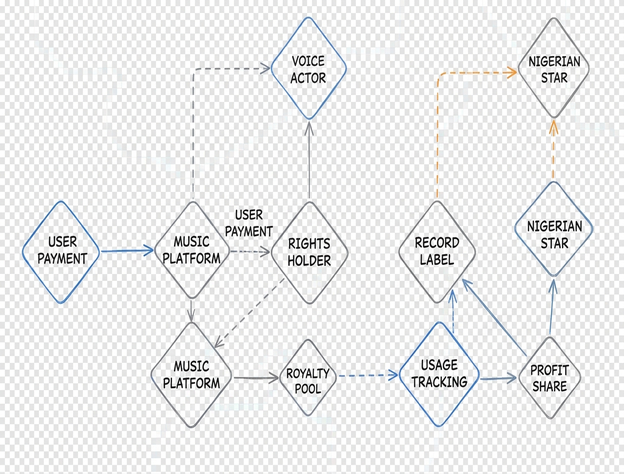
Timing keeps that pipeline open longer than most fans realise. Distributor royalty reporting typically lags actual plays or downloads by 60 to 90 days, meaning an imitation track can quietly stack revenue across two or three reporting cycles before a dispute ever surfaces. When a label spots the fake and files a takedown or ownership claim during that window, the distributor can freeze the pending balance or redirect it to the rightful claimant. However, on platforms that run notice-and-counter-notice procedures modelled on US law, removed audio can be restored 10 to 14 business days after an uploader files a counter-notice, unless the complainant files a lawsuit. Brazen uploaders exploit that exact two-week gap to keep cashing out while a claim is contested.
Pulling an artist back into that money chain requires untangling the legal bundle inside a song. A cloned Afrobeats single involves three separate rights. The master belongs to whoever rendered the file. The composition may be lifted from the headliner's own catalogue. The voice and persona can only be defended through passing-off or personality theories. Of these, only the voice points back to the imitated star, and it is exactly the one the Copyright Act 2022 leaves untested.
Signed in March 2022 to replace the 1988 Act, Nigeria's Copyright Act 2022 is administered by the Nigerian Copyright Commission. While the law protects musical works and sound recordings and sets notice-and-takedown duties for online service providers, it does not expressly address AI-generated imitations of a living artist's voice, and no definitive court ruling has settled the question yet. All of this is framed through Nigerian law; a diaspora fan buying from a site hosted in the UK, the US, or elsewhere deals with that country's personality and publicity rules instead, which range from strong vocal protection to almost none. Meanwhile, codnima's industry coverage shows that label and management complaints focus as heavily on false attribution and diverted fan attention around real release dates as they do on lost naira.
Red Flags on Download Pages That Signal a Misleading AI Track
Spotting a synthetic clone before you hand over your card details starts with a quick audit of the listing from the outside in. Start with the fastest visual checks on the page, then move to the audio only if the metadata looks clean.
- Missing or mismatched visual credits: Check the metadata for a real record label and producer credit. Deceptive uploads frequently leave the label line blank or slap together cover art that clashes with the artist's current visual era.
- Silence on verified channels: Cross-check the artist's verified Instagram, X account, official website, and verified streaming profile. If a track is sold as "new" or "leaked" on a random blog without a single teaser on the star's real pages, step back.
- Flattened tonal delivery in local languages: Listen closely to how the vocals handle indigenous lines. Yoruba uses three lexical tones (high, mid, low) and Igbo is likewise tonal; voice models trained mostly on English vocals frequently flatten or misplace these pitches, producing Yoruba or Igbo lines that make no sense in meaning even when sitting in tune with the beat. Pidgin phrasing often lands with awkward, unnatural stress.
- Mechanical vocal artifacts: Ear-test the preview for breaths that repeat at identical intervals, ad-libs that smear into the lead vocal rather than sitting on a separate layer, and a flat emotional intensity that never shifts from verse one to the outro. Treat audio tells as a secondary hint only, since voice models improve every month.
- Burner uploader profiles: Inspect the seller's history. A classic suspect profile is less than one month old, dumps "unreleased" songs from several competing headliners at once, and avoids writing the words "AI", "cover", or "tribute" anywhere in the description.
Single-Blog Upload Rule
Treat any single that exists only on one download blog or a single uploader profile as unverified until the artist or their label confirms it publicly.
Worked Case: Vetting a 'Leaked' Afrobeats Single Before You Pay
The point where a Naija download stops being a fan curiosity and becomes a payment to an impersonator is when a 'Leaked' title, a blank label field and an uploader account under a month old all appear on the same listing, with no mention anywhere on the headliner's verified channels. Here is how to run a six-step verification check on your phone the next time a tempting link drops into your group chat.
Imagine a paid download titled "[Headliner] – [Title] (Unreleased)" gets forwarded across several WhatsApp groups you belong to, linking out to a single download blog where it is priced as a premium single. Before tapping the payment button, walk through this exact sequence:
- Search the artist's verified feeds: Open the headliner's verified Instagram, X profile, and official streaming page to scan posts and stories from the past 30 days. In our case, the title appears nowhere on their feeds.
- Audit the listing metadata: Look at the fine print on the download page for a distributor name, label credit, and release date. Here, both the label and distributor fields sit completely blank, no release date is listed, and clicking the uploader's name reveals the account was created just two weeks ago.
- Scan the description for disclosure: Read the upload notes for any honest framing. Our suspect page contains zero AI disclosure while leaning hard on the word "Leaked" in the header.
- Run a 30-second recent-release ear test: Play the preview and compare a 20- to 30-second ad-lib passage against a verified song the artist released within the last 12 months, rather than an older classic hit, so you are matching their current vocal texture. In the suspect file, the vocal stays locked at one flat intensity throughout, and the Pidgin hook stresses the wrong syllables.
- Hold your money and flag the link: Do not pay for the file. Hit the report or impersonation flag on the hosting platform, then watch the artist's official channels for confirmation of a genuine surprise drop.
- Buy only via official redirect: If the song eventually turns out to be a labelled, artist-authorised AI project, purchase it solely through the direct link posted by the artist or their label so your money reaches the people who actually consented.
Pre-Purchase Verification Result
In this example, the blank credits, missing disclosure and silence on the headliner's verified feeds leave the WhatsApp link unverified. The buyer reports the listing without paying, so the anonymous uploader gets none of their naira.