In this Article
- The Silence Before the Hook
- How We Assessed Her Craft: The Criteria for Restraint
- Space as an Instrument: The Architecture of Absence
- Phrasing and Cadence: The Weight of a Delayed Word
- Vocal Texture: Grain, Rasp, and Deliberate Imperfection
- Emotional Precision: Saying Less to Mean More
- The Feature Effect: Restraint as a Collaborative Weapon
- The Minimalist Blueprint: Why Restraint Travels
- Why This Reading Fits codnima’s Editorial Beat
- The Next Listen
The Silence Before the Hook
The first several seconds of “Free Mind” do not announce themselves with a crowded entrance.
A pad hangs in the air. Tems’ voice enters with physical restraint, close enough to feel almost unperformed, while the rhythm waits outside the room. Nothing rushes to decorate the line. The arrangement carries little more than voice and atmosphere before the beat begins to define the floor beneath her.
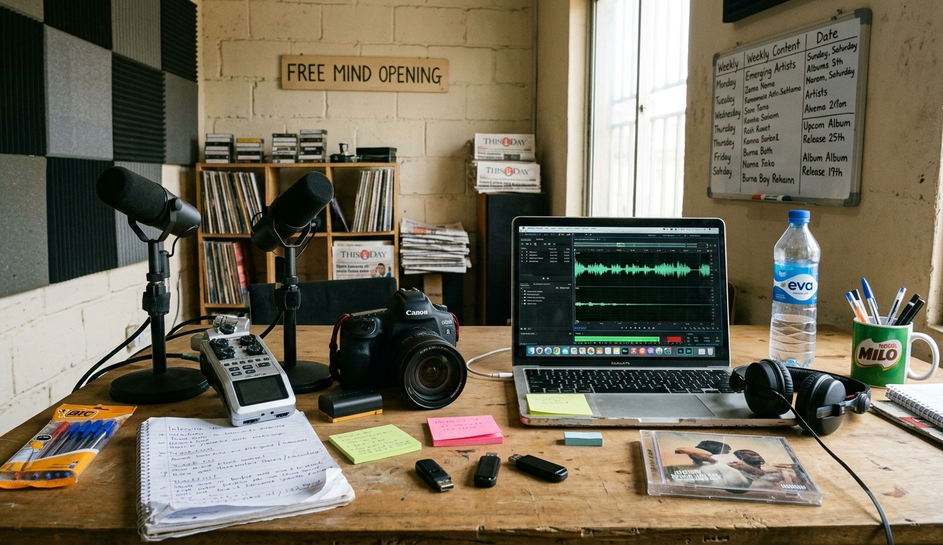
That opening matters because it states the central grammar of her songwriting before any analysis can overexplain it: Tems’ power lives in what she leaves out. Afrobeats often thrills through density, with percussion, log drum, ad-libs, stacked vocals, and melodic movement pulling the listener into constant motion. Tems moves differently. She withholds, then lets the smallest arrival feel large.
“Essence,” released in 2020 as an album cut and carried into global attention across 2021 and 2022, offers another entry point. Her verse lands with a held breath before the melody fully settles. Yet “Free Mind” makes the argument sharper because the opening bars strip the room down to its essentials.
Main Point: The minimalist edge in Tems’ songwriting is not a lack of material. It is a compositional choice that turns silence, delay, and vocal grain into active musical forces.
How We Assessed Her Craft: The Criteria for Restraint
This analysis uses four lenses: use of space, phrasing and cadence, vocal texture, and emotional precision.
Those lenses were chosen because they recur across commercially released, widely available recordings from roughly 2019 to 2023, whether Tems appears on solo cuts or guest verses. Unreleased sessions and leaked demos sit outside the frame. The point is not to reconstruct private studio intent; the point is to read the artifact listeners actually receive.
The genre context matters. Chart-leaning Afrobeats from the 2021 to 2023 cycle often keeps the bar alive through layered percussion, log drum, shaker, vocal responses, and rhythmic fills. Against that baseline, restraint becomes legible as technique rather than absence. A sparse bar sounds more radical when the surrounding musical culture usually rewards constant movement.
The evidence base here stays qualitative: song structures, feature placements, audible arrangement decisions, and listener commentary from her 2021 to 2023 rise. Caution: these lenses privilege the recorded artifact, so any craft decision made in mixing that the credits do not disclose sits outside what this reading can defensibly claim.
1. Space as an Instrument: The Architecture of Absence
Tems often leaves gaps where other Afrobeats records would fill every bar.
In several solo cuts, percussion recedes or thins at the transition into the hook. For a bar or two, the track lets voice and sustained low-end hold the emotional weight before the beat returns. That move changes the listener’s posture. Instead of riding a dense groove from front to back, the listener leans forward to locate the next phrase.
This is not emptiness. It is architecture.
Contemporary chart Afrobeats frequently builds momentum through continuity: the shaker keeps time, the log drum pushes the waistline, ad-libs answer the lead vocal, and the mix rarely allows a clean void. Tems works against that density baseline. Her arrangements create pockets where a single phrase can behave like a drum hit because nothing else competes for attention.
Expert Tip: On headphones or monitored playback, her low-frequency space reads as deliberate pressure. On phone speakers, the same choice can sound thin or underproduced, which is why playback context changes the interpretation.
The strongest effect arrives when the gap precedes a hook. The hook does not need to be larger in production terms. It only needs to re-enter after enough absence for the ear to feel its return.
2. Phrasing and Cadence: The Weight of a Delayed Word
Tems often sits a fraction behind the downbeat.
That small delay gives her lines tensile force. A resolving word arrives at the end of a phrase rather than at the earliest expected point, and two-to-four-word lines stretch across a full bar. In a genre space where many 2020 to 2023 chart features favor rapid multi-syllable patterns, her fewer-words-per-bar approach changes the temperature of the track.
The delivery feels conversational, but not casual. She lets the rhythm move first, then answers it with a line that sounds like it has chosen its moment. Repetition becomes hypnotic because the phrase returns with slight pressure, not because the bar is packed with syllables.
There is a technical consequence here: delay creates tension without adding density. A producer can leave the arrangement open because the vocal itself supplies motion through placement. The phrase does not chase the beat. It bends around it.
Caution: The behind-the-beat reading only holds when a steady quantized grid exists. On free-tempo or rubato passages, there is no fixed pulse against which that delay can be measured.
3. Vocal Texture: Grain, Rasp, and Deliberate Imperfection
Her signature lives in the smoky lower-to-mid register.
The vocal does not arrive as a polished surface with every breath removed. Breath, slight cracks, and rasp remain audible in final masters across much of her 2019 to 2023 output. The result feels close to the body: throat, air, pressure, restraint.
That grain performs cultural work. Across the global diaspora, listeners often read unvarnished texture as a signal of emotional credibility, especially when the surrounding production stays spacious enough to let the voice remain forward. The point is not that rawness equals truth in any simple way. It is that the preserved artifact of effort makes the performance feel less manufactured.
Audio suggests a lighter vocal frame: compression and reverb support the voice without burying its rough edges, while aggressive tuning does not dominate the ear. Without published session details, the exact chain remains an inference from the sound rather than a documented production fact.
That distinction matters. The craft is audible; the private method is not fully knowable.
4. Emotional Precision: Saying Less to Mean More
Tems’ hooks often repeat a short phrase and let melody carry what literal detail might otherwise explain.
This is lyrical economy, not lyrical emptiness. A few words hold heavy emotional load because the surrounding space gives them time to resonate. The listener is not handed a complete narrative with names, dates, scenes, and resolutions. Instead, they receive an emotional contour and supply the missing interior detail.
Mainstream Afrobeats can be brilliantly literal, especially when artists build stories through flirtation, celebration, street memory, or direct confession. Tems often favors a more suspended mode. She names the feeling, then refuses to over-narrate it.
Listener commentary across her 2021 to 2023 rise repeatedly frames these records as intimate and open to personal projection. That response makes sense. Ambiguity creates a receiving space. One person hears survival, another hears romantic exhaustion, another hears spiritual release.
Main Point: Her emotional precision comes from controlled under-writing: the lyric opens the door, while the melody and negative space determine how long the listener stays inside.
5. The Feature Effect: Restraint as a Collaborative Weapon
A crowded track can make restraint sound enormous.
That is the feature effect. When Tems appears beside denser vocalists or inside more maximalist productions, her contained verse works as a textural counterweight. The track may move fast around her, but her line slows the center of gravity. Instead of competing for volume, she competes through contrast.
Her run of prominent international features across 2020 to 2022 gave that approach its widest audience. The timing matters because it overlaps with the breakout arc that carried “Essence” from album cut to global reference point. In that window, her voice became recognizable not through excess branding language, but through a repeatable sonic behavior: hold back, darken the tone, land the phrase late, leave air around it.
Placed beside an equally sparse collaborator, the contrast-driven impact changes. Restraint stands out most clearly when the surrounding record is busy. If both artists occupy the same minimal lane, the verse must win through melody, writing, or texture rather than through opposition.
That is why her best feature moments feel less like guest appearances and more like rebalancing acts.
6. The Minimalist Blueprint: Why Restraint Travels
Minimalism lowers the comprehension barrier.
For diaspora audiences and non-lyric-parsing listeners, the melodic hook can do cross-market work before every word is understood. Reduced lyrical load makes the phrase easier to retain. Clear space around the vocal makes the emotional signal easier to locate. The record travels because the listener can feel the architecture without needing to decode every linguistic layer in real time.
Space-conscious, less densely layered production has become more visible in Afrobeats across the 2021 to 2024 stretch. Tems belongs to that current. She is not the sole origin point, and the genre remains too diverse for any single artist to explain its whole movement. Her influence is one significant strand among several: producers, songwriters, DJs, platform discovery, diaspora circuits, and changing audience habits all shape the field.
One catch: the same restraint that travels internationally can struggle against streaming-era pressure for an immediate front-loaded hook. Her blueprint trades instant grab for slow-build intimacy. That trade can be powerful, but it asks the listener to give the record a little room.
Expert Tip: The export lesson is not “make Afrobeats slower.” It is “decide which element deserves silence around it, then protect that silence.”
Why This Reading Fits codnima’s Editorial Beat
codnima’s editorial work sits at the intersection of music news, artists, albums & eps, mixtapes & playlists, and longform features. The ongoing coverage of Nigerian music trends across recent release cycles gives this kind of craft reading a practical frame: songs do not move globally through vibe alone. They move through decisions about structure, placement, repetition, and audience recognition.
This reading reflects an analytical interpretation of the records. Artists and producers may describe their own intent differently in interviews, and those accounts can deepen or complicate the sonic evidence. Still, the recorded material gives enough ground to identify recurring choices.
Tems’ minimalist songwriting matters because it clarifies a broader export question for Afrobeats: what happens when the genre’s rhythmic confidence meets a writer who trusts silence as much as percussion?
The Next Listen
Replay one Tems track with full attention, preferably on headphones, and mark every point where the arrangement thins, drops out, or lets the vocal stand almost alone.
Then tag each moment with one of the four lenses: space, phrasing, texture, or emotional precision. In one focused listen of a few minutes, the argument becomes audible.